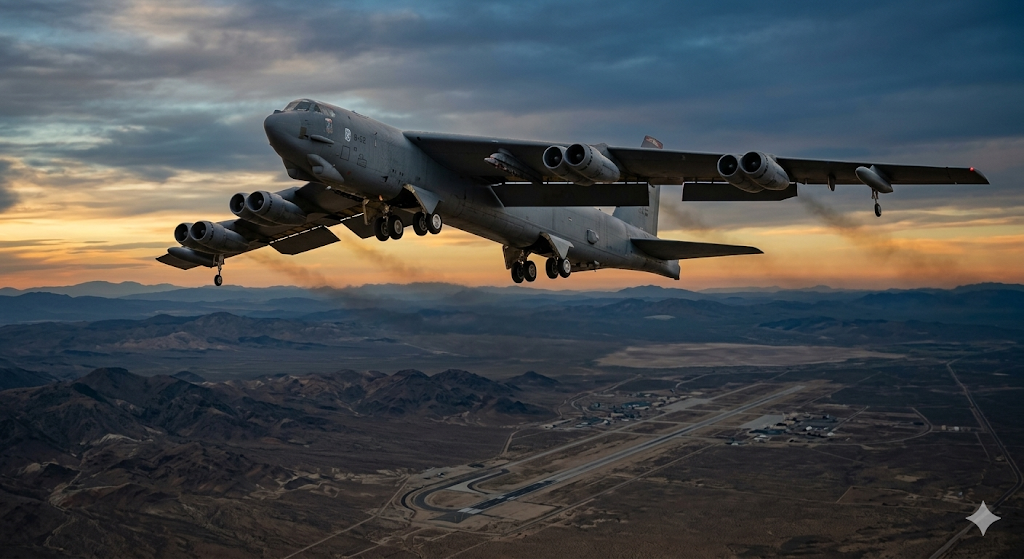
In the world of military aviation, newer usually means better. Stealth coatings, supersonic speeds, and unmanned artificial intelligence dominate modern defense headlines. Yet, sitting quietly at the apex of global strategic power is an aircraft designed in the era of black-and-white television: the B-52 Stratofortress, affectionately known by its crews as the BUFF (Big Ugly Fat Fellow).
First taking to the skies in 1952, this eight-engine titan has outlived the Soviet Union, outpaced its intended replacements, and continues to serve as the ultimate backbone of American air power. Here is a deep dive into the engineering marvel and the sheer capability that keeps this Cold War icon flying high.
1. Mind-Boggling Payload and Global Reach
The B-52 was built for one primary purpose: to carry massive amounts of ordinance over intercontinental distances without needing to land. Decades later, its capacity remains staggeringly unmatched.
- 70,000 Pounds of Firepower: The B-52 can carry an astonishing 70,000 pounds (31,750 kg) of weapons inside its massive bomb bay and underneath its wings. This includes everything from conventional gravity bombs and precision-guided joint direct attack munitions (JDAMs) to nuclear-tipped cruise missiles.
- Unparalleled Combat Range: With an unrefueled combat range exceeding 8,800 miles, a B-52 squadron can take off from the United States, strike a target virtually anywhere on the globe, and return home safely with the help of mid-air refueling.
2. The 100-Year Aircraft: Engineering Longevity
What makes the B-52 truly legendary isn't just what it can carry, but how long it has been carrying it. The airframes flying today are older than the pilots operating them, yet they are structurally sounder than many modern jets.
Thanks to a multi-billion-dollar Pentagon initiative known as the B-52J Modernization Program, the fleet is currently undergoing its most radical transformation yet:
- Commercial Engine Replacement Program (CERP): The aging Pratt & Whitney engines are being replaced with brand-new, highly efficient Rolls-Royce F130 engines. This upgrade increases the bomber’s fuel efficiency, extends its range, and significantly reduces maintenance hours.
- Digital Cockpit and Radar Overhaul: The analog gauges of the past are giving way to advanced digital glass cockpits and cutting-edge AESA (Active Electronically Scanned Array) radar systems, the same technology used in modern fighter jets.
With these upgrades, the U.S. Air Force plans to keep the B-52 operational until at least the 2050s. This will make it the first aircraft in aviation history to achieve 100 years of continuous active military service.
3. The Ultimate Standoff Platform
While the B-52 is no longer expected to fly directly into heavily defended enemy airspace due to its lack of stealth, its role has evolved beautifully into a Standoff Launch Platform.
Because of its massive size and structural strength, it is the premier vehicle for launching tomorrow's warfare technology, including hypersonic missiles. Operating safely hundreds of miles away from enemy air defenses, a single B-52 can launch devastating, high-speed precision strikes from total safety, proving that raw carrying capacity is sometimes far more valuable than stealth.
💡 The Blogger's Take
The B-52 Stratofortress is a living testament to brilliant aerospace engineering. It proves that a fundamentally perfect design, combined with continuous modernization, can outlast any tech trend. It isn't just a relic of military history; it remains an active, flying instrument of global power projection that will continue to shadow the horizons of tomorrow.
What do you think is the most impressive aspect of the B-52? Is it the massive payload, or the fact that it will fly for a full century? Let’s get a discussion going in the comments below!